
Reply To: THE PUZZLE OF MURDER-BY-GUN STATISTICS
Homepage › Forums › Small Talk › THE PUZZLE OF MURDER-BY-GUN STATISTICS › Reply To: THE PUZZLE OF MURDER-BY-GUN STATISTICS
 SteveInCO
I did NOT claim that the “study references non-murders only.” Furthermore the diagram doesn’t make any such claim either. It appears that you don’t know how to read a Venn (or Euler) diagram.
Set A: All Firearms Related Deaths. The circle on the left. This is what the study addressed, and they painstakingly list all the codes and categories that are included, SOME, but ONLY some, of which are murders.
Set B: All Murders. The circle on the right.
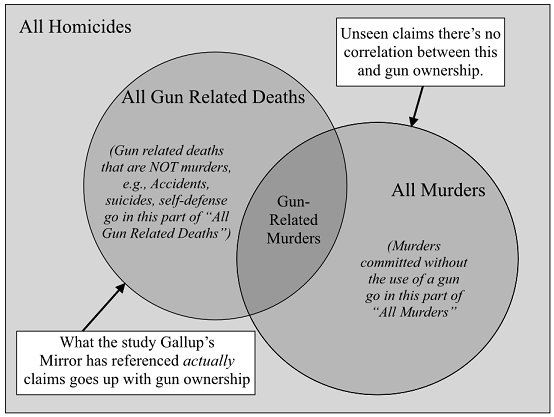
Firearms-related murders is the darker-shaded overlap between the two circles (the intersection of A and B, written A∩B) and is CLEARLY included in Set A, the subject of the study. (The intersection of two sets is by definition part of both sets.) I NEVER said otherwise.
Let me rephrase that for clarity: Far from excluding firearms related murders as you seem to think, the diagram I produced specifically calls that category out and shows it as included in set A.
Firearms related murders (the darker overlap) is also a part of B, murders, by definition.
The study does show that the aggregate total of everything in A increases with G (gun ownership). They very carefully and accurately phrased their conclusion: “The number of guns per capita per country was a strong and independent predictor of firearm-related death [i.e., the per-capita size of set A] in a given country” They aren’t talking about set B, or even the intersection of A and B, A∩B. They’ve accurately described what they’ve shown.
[That study reaches other interesting conclusions as well.]
The problem comes in claiming that a conclusion about a correlation between set A and factor G (Gun ownership) necessarily implies that there is one between set B and factor G. You can’t do that, because there are elements in Set A that aren’t in set B and vice versa, and they could all vary or not in totally different ways with G. Yet on multiple occasions you’ve characterized this study as having something to say about a correlation between G and B, or simply treated A and B as equivalent sets.
You cannot even conclude that showing that G affects A necessarily even affects the size of the area of the intersection; it’s a logical possibility that ALL of the growth of A as G increases occurs in the area outside the intersection. (Mind you, I doubt that’s actually the case, but until they produce a study that does NOT include firarms-related accidental deaths, assaults, suicides, etc. and ONLY includes firearms-related murders, A∩B, we don’t KNOW.)
And that, explained for what must be the fourth or fifth time, is your error. This study has nothing conclusive to say about Unseen’s original contention that the murder [by all methods] rate doesn’t correlate to firearms ownership, because it simply does not address the murder [by all methods] rate, and only includes part of that category in the data that it does aggregate.
