
Trump's destruction of the American economy is almost brilliant
- This topic has 4 replies, 2 voices, and was last updated 1 year, 4 months ago by
 _Robert_.
-
AuthorPosts
-
May 28, 2025 at 5:56 pm #57534
 UnseenParticipant
…and could hardly be more destructive if it were designed by our worst enemies on the world stage, meaning Russia, China, and Iran.
Some companies are likely to fall by the wayside due to Trumponomics, but the negative impacts are unlikely to stop there.
Companies which may not suvive include Target, Walmart, Nike, Levis, GM, Ford, and even Tesla, but they are just at the very tip of the iceberg. These are some of the household names that may not survive Trump’s totally needless trade war with the world.
At the other end are countless small companies who depend on Chinese, Indian, Indonesian, Vietnamese and, yes, Mexican companies to supply them with low-cost supplies, parts, or finished products. While a few (very few) are mom and pop operations employing mom or pop or both, the vast majority employ anywhere from a few to a fairly large number orf employees who will be out on the pavement if they can’t sell their goods at attractive prices.
When companies manage to survive initially, their products may become significantly more expensive. For example, domestically produced iPhones, made with American raw materials, American-made parts, and using American labor, are estimated to cost around $3000 each. Will they be competitive at that price point? Only if the competition’s phones are similarly more expensive.
Will we all be forced back to the kind of wired and dumb phones we used to use before iPhones and Androids came along? Yeah, could be, which would be sad if folks outside our borders remain in the 21st Century when it comes to telephonic tech.
And, of course, computer tech would be in a similar position with, for example, the desktop-equivalent laptop I recently bought for around $300 costing nearly three times more.
I asked Google’s Gemini AI for a list of major companies whose survival is threatened by president trump’s tariff war and got this response.
**********
President Trump’s trade policies, particularly the imposition of tariffs, have created significant challenges for various major companies and industries, threatening their survival or at least impacting their profitability and operations. While it’s difficult to list companies definitively “on the brink of survival” solely due to tariffs, here are major companies and sectors that have been significantly threatened or impacted:
Companies and Industries Directly Impacted:
Retailers with High Import Dependence: Companies like Walmart and Target are heavily reliant on imported goods, especially from China, Vietnam, and Bangladesh. Tariffs increase their costs, which they may pass on to consumers through higher prices, potentially affecting sales and margins. Walmart has already indicated it will be raising prices and has undergone corporate layoffs, although they insist these are not solely due to tariffs.
Apparel and Footwear: Brands such as Nike, Gap, and Levi’s source a significant portion of their products from Asian factories. Tariffs on clothing and shoes from countries like China, Vietnam, and Bangladesh directly increase their costs, leading to potential price hikes for consumers or eroded profit margins.
Consumer Electronics and Tech Hardware: Companies like Apple, Dell, HP, and Cisco rely heavily on manufacturing in China and components from places like Taiwan and South Korea. Tariffs on these imports can significantly increase production costs for devices like smartphones, laptops, and networking equipment. While some large tech companies like Apple have announced investments in U.S. manufacturing, the scale of current reliance on overseas production makes them vulnerable.
Semiconductor Companies: While some U.S. chipmakers like Nvidia, AMD, and Intel are expanding domestic production, they still depend on foreign foundries (like TSMC in Taiwan) and global supply chains for advanced chip fabrication and components. Tariffs on semiconductors from key manufacturing hubs could raise costs across the tech sector.
Automakers and Auto Parts Suppliers: Companies like General Motors, Ford, and Tesla have significant exposure to imported raw materials (like steel and aluminum) and foreign-made auto parts. While tariffs on imported vehicles might benefit some domestic production, the increased cost of imported components can lead to higher vehicle prices and dampened consumer demand.
Toy Manufacturers: Mattel announced plans to raise prices for some of its toys sold in the U.S. to offset higher costs from tariffs, as a significant portion of their global production is in China.
Broader Industry Concerns:
Agriculture: U.S. agricultural exporters, particularly soybean, corn, and pork farmers, faced significant revenue losses due to retaliatory tariffs from countries like China during the previous trade war. While specific companies are not usually named as “on the brink,” the collective impact on the industry and individual farmers can be severe. Major food companies like Cargill, Archer Daniels Midland, and Tyson Foods could also lose export earnings.
Heavy Machinery and Construction Equipment: Manufacturers like Caterpillar rely on imported steel and components. Unlike steel producers, they may struggle to pass these increased costs to customers due to global competition.
Airlines and Hospitality: Tariffs that raise fuel and food costs (e.g., on Canadian oil or Mexican produce) can impact companies like Delta or Marriott, making it difficult to maintain profitability without passing costs to price-sensitive consumers.
Small Businesses: Many small businesses, especially those relying on specific imported goods (like specialized sports equipment or olive oil), face significant challenges in adjusting to higher tariff costs and potential cash flow disruptions.
It’s important to note that companies often try to mitigate the impact of tariffs through strategies like diversifying supply chains, negotiating with suppliers, or absorbing some of the costs. However, for companies with narrow margins or heavy reliance on affected imports, the prolonged pressure from tariffs can significantly threaten their financial stability and long-term survival.
May 28, 2025 at 7:27 pm #57537 _Robert_Participant
US corporate management decided long ago to outsource manufacturing labor. Labor and environmental regs (so we aren’t drinking carcinogens) are a pain in the ass. We were going to be the managers, the engineers, the world’s bank, the world’s educator, and the world’s example of a wealthy democracy. It did bring incredible wealth to the rich but of course it didn’t trickle down as advertised.
So now what? Americans are supposed to go back to sitting on assembly lines making plastic widgets for Walmart? Not gonna happen. Whatever manufacturing that moves back here will be automated. Few new jobs for the average Trump voter. Everything is just gonna cost more and the dollar is no longer to be trusted.
May 29, 2025 at 3:18 pm #57541UnseenParticipantUS corporate management decided long ago to outsource manufacturing labor. Labor and environmental regs (so we aren’t drinking carcinogens) are a pain in the ass. We were going to be the managers, the engineers, the world’s bank, the world’s educator, and the world’s example of a wealthy democracy. It did bring incredible wealth to the rich but of course it didn’t trickle down as advertised. So now what? Americans are supposed to go back to sitting on assembly lines making plastic widgets for Walmart? Not gonna happen. Whatever manufacturing that moves back here will be automated. Few new jobs for the average Trump voter. Everything is just gonna cost more and the dollar is no longer to be trusted.
Speaking of automation, someone who ought to know is predicting that about 50% entry-level jobs will be going bye bye possibly as soon as 5 years from now, raising unemployment levels to +/-20%. It’s time we seriously start planning for a future without work.
BTW, without entry-level jobs, where do those at the higher levels get real world experience before assuming their positions?
May 30, 2025 at 4:04 pm #57546UnseenParticipantUS corporate management decided long ago to outsource manufacturing labor. Labor and environmental regs (so we aren’t drinking carcinogens) are a pain in the ass. We were going to be the managers, the engineers, the world’s bank, the world’s educator, and the world’s example of a wealthy democracy. It did bring incredible wealth to the rich but of course it didn’t trickle down as advertised.
So now what? Americans are supposed to go back to sitting on assembly lines making plastic widgets for Walmart? Not gonna happen. Whatever manufacturing that moves back here will be automated. Few new jobs for the average Trump voter. Everything is just gonna cost more and the dollar is no longer to be trusted.
ODE TO THE TRUMP TARIFF TRAGEDY
In a land of plenty, where people are free,
Lived a man named Trump, who made a peculiar decree.
He’d gaze at the factories, the fields, and the shore,
And declare, with a huff, “We need even more!”He’d talk of the past, with a glint in his eye,
Of a greatness departed, he thought, that needed reply.
“These goods from afar, they weaken our might!
Tariffs, high tariffs! will set all aright!”But the nation was thriving, its spirit so bright,
Innovators abounding, both morning and night.
But Trump, in his delusion, saw what wasn’t there,
Proposing walls and fences, not bridges and stairs.He promised prosperity, jobs back to the nation.
Though business realities would require automation.
He spoke of “America First!” with a strong angry growl,
While the world, interconnected, ignored his sad howl.The people, confused, some cheered and some jeered,
As Trump built his walls, with a nationalist’s fears.
The prices went up, the choices grew few,
And the “greatness” he promised felt strangely askew.For greatness, you see, isn’t built on a wall,
But on open exchange, where ideas stand tall.
It’s built on connection, respect, and cooperation
Not fear of the foreign or embracing isolation.So Trump, with his tariffs, stood firm and deranged,
While the nation, still great, felt no need to change.
For sometimes, the vision, though fiercely expressed,
Misses the point and is wrongly addressed.-
This reply was modified 1 year, 4 months ago by
 Unseen.
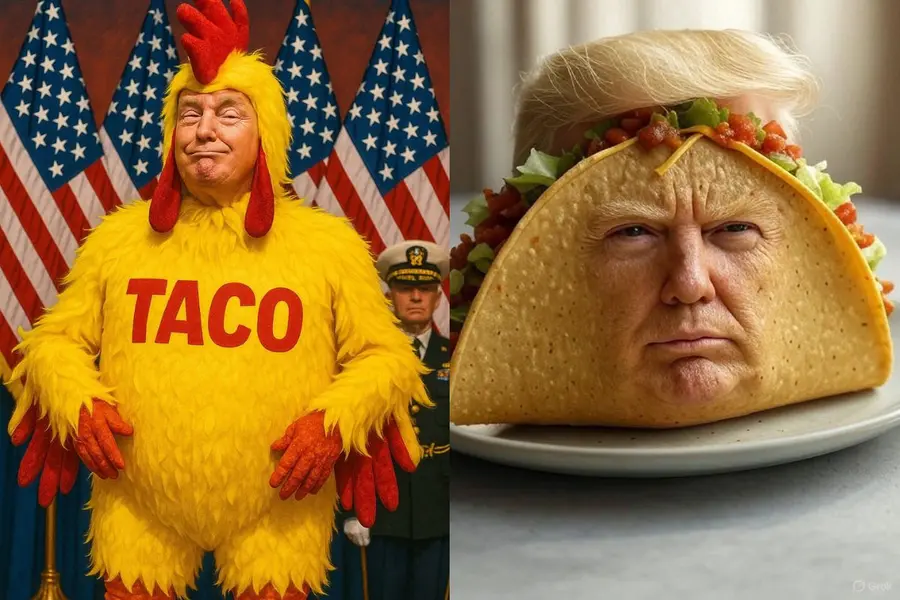
May 30, 2025 at 4:08 pm #57548_Robert_ParticipantTrump Always Chickens Out
-
This reply was modified 1 year, 4 months ago by
-
AuthorPosts
- You must be logged in to reply to this topic.