
IS EVIL REAL? OR, LIKE GOD, A HUMAN INVENTION?
Homepage › Forums › Small Talk › IS EVIL REAL? OR, LIKE GOD, A HUMAN INVENTION?
- This topic has 179 replies, 11 voices, and was last updated 8 years, 5 months ago by
 Unseen.
-
AuthorPosts
-
May 6, 2018 at 2:23 am #9017
 jakelafortParticipant
I am not sure what you are saying Simon.
Are you disagreeing with me and if so how?
May 6, 2018 at 4:08 am #9018 UnseenParticipant
What of ethics? Are ethics simply matters of opinion in which acts can never be judged? Are ethics necessarily a reflection of one’s tribe or culture?
You just said it yourself. Ethical statements are judgments (“I adjudge so and so to be wrong”) and thus are mere opinions or expressions of attitudes. Where do you imagine you get the values that give you those opinions and attitudes?
May 6, 2018 at 4:34 am #9021jakelafortParticipantYes, Unseen, ethics are judgments. Judgments subsume matters such as who we date, who we befriend, how we spend our time, whether a horse’s odds are a true reflection of the probabilities.
You say judgments are opinion. Agreed. But the way you characterize opinions with a seeming derision. Mere? Why mere. One’s judgment is the culmination of our magnificent brains and the serpentine and improbable path that lead us to be us.
Further you say ethics are expressions of attitudes. If by that you mean to convey the idea that attitudes are simply feelings you are mistaken-IN YOUR JUDGMENT!
Ethics is a matter of applied reason. Feelings may be associated with ethics but feelings are not seminal to their genesis.
May 6, 2018 at 5:00 am #9022D
ParticipantEthics is a matter of applied reason.
If only that were mostly so Jake. If only. This is true when we are in the realm of applied ethics, legal debates and enlightened discussion. However, ethics all to often by-pass anything we’d recognize as reason. Consider this: in a large amount of countries…the most intellectual and prestigious and prized ethicists…are sharia law interpreters. Their underlying axiom may be grossly flawed, but once God’s elementary laws are established…they use stunning logical precision to find rules that deal with ordinary problems with applied reason…frequently resulting in incredible cruelty. And the Sharia-ists aren’t alone. Reason is well applied, and yet the results, mostly due to some fundamental premises…are obscene. I agree with a lot of what you say Jake, but there is fundamentally more to it than just applied reason, and it is still in the realm of opinion. We are lucky to live in countries where those opinions have us living sufferable lives.
May 6, 2018 at 5:12 am #9025jakelafortParticipantDavis, to give an addendum to my most recent reply to Unseen, those are MERE opinions. I don’t consider it ever ethical (unless it is incidental…for example formulations of the golden rule) if it is a result of ideology, mythology or superstition. Those opinions are delivered to the believer by fiat and rely on authority, not reason.
So i distinguish the two.
May 6, 2018 at 6:01 am #9026ParticipantSo i distinguish the two.
Yes. Got it!
May 6, 2018 at 10:31 am #9027 Simon PayntonParticipant
@jakelafort – I was agreeing with you. There are factual aspects of an ethical judgement. First there’s the action itself, which is is a given fact. Then there are judgements of how the action fits various ethical criteria – how did it score on fairness, reciprocity, unconditional harm, whatever. If we understand what these are about, we are well placed to make judgements concerning this.
M E Thomas (“Confessions of a Sociopath”) distinguishes between descriptive and normative judgements, and I suppose these would be normative judgements.
May 6, 2018 at 10:43 am #9028Simon PayntonParticipant@unseen – “Where do you imagine you get the values that give you those opinions and attitudes?”
– personal thriving (balanced with the thriving of others).
– cultural norms (those “twisting gardens of rules”).
May 6, 2018 at 10:48 am #9029Simon PayntonParticipantI also agree with @davis – if you don’t have the right starting premises, the whole thing’s fucked.
May 6, 2018 at 3:36 pm #9034UnseenParticipantM E Thomas (“Confessions of a Sociopath”) distinguishes between descriptive and normative judgements, and I suppose these would be normative judgements.
Doesn’t matter. Anytime you adjudge something, you’re saying “This is what I think” not “This is what I know.” The only fact involved is an unshareable state of mind, known only to you, not a state of affairs in the external world.
-
This reply was modified 8 years, 5 months ago by Unseen.
May 6, 2018 at 5:45 pm #9036Simon PayntonParticipant@unseen – “The only fact involved is an unshareable state of mind, known only to you, not a state of affairs in the external world.”
– yes, but there is the fact of the act itself, together with the ethical concepts against which it is measured.
May 7, 2018 at 2:27 am #9047UnseenParticipantthere is the fact of the act itself, together with the ethical concepts against which it is measured.
Those ethical concepts are artifactual, not built into reality.
May 7, 2018 at 2:52 am #9048jakelafortParticipantUnseen, do you differentiate between human concepts? Are all concepts artifactual?
If not how is an ethical concept to be distinguished from a scientific concept, a legal concept, a linguistic concept?
May 7, 2018 at 6:33 am #9053Simon PayntonParticipant@unseen – “Those ethical concepts are artifactual, not built into reality.”
– they’re scientific concepts. Do you not agree with the concept of concepts? Do you think that they’re not a thing? How do you account for mathematics?
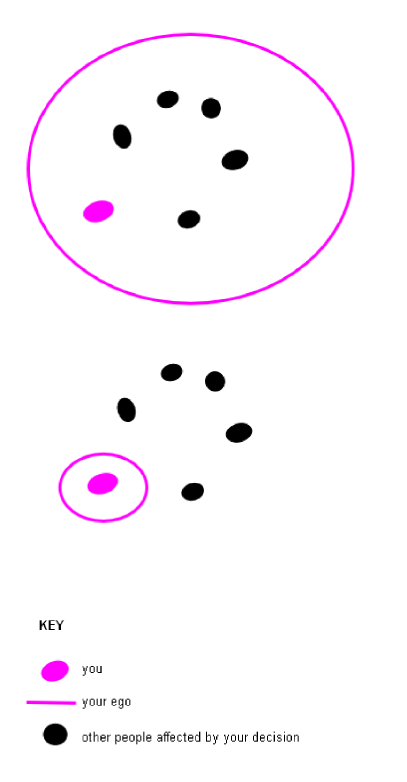
May 7, 2018 at 8:16 am #9054Simon PayntonParticipantThis is an ethical concept (“Perfect Compassion”). We can make a judgement, for a given action, whether the actor was only thinking of themselves, or of all those affected, or somewhere in between. We can evaluate the action in the light of this concept.
-
This reply was modified 8 years, 5 months ago by
-
AuthorPosts


- You must be logged in to reply to this topic.