
Love Never Fails
Homepage › Forums › Small Talk › Love Never Fails
- This topic has 23 replies, 6 voices, and was last updated 8 years, 9 months ago by
 Simon Paynton.
-
AuthorPosts
-
October 1, 2017 at 9:56 am #5689
 Simon PayntonParticipant
@tomsarbeck – “please consider moving tit-for-tit to the middle middle of your spectrum. At the end tit4tat formerly occupied, put sociopathy.”
– you’re probably right actually.
Another feature of a long term working relationship is “respectful protest”: taking someone to account in a respectful way, with the assumption that each person is a reasonable person.
October 1, 2017 at 10:50 am #5690Simon PayntonParticipant@tomsarbeck – another definition of tit-for-tat reciprocity is “fairness in exchanges”, so your idea makes sense in that context. i.e. it’s not fair if someone is evil to you for no reason.
October 1, 2017 at 12:50 pm #5693 _Robert_Participant
I would define love as mutual respect and caring; but the quality of such love can be lessened by the degree of dependency.
October 1, 2017 at 2:59 pm #5695 jakelafortParticipant
Tom, I am impressed. You diagnose the women in my life without knowing them. I guess that makes you god. Say Tom, i seem to have a growth on my neck. Is it malignant?
Love happens when pain can bring understanding, not revenge.
That is a good line.
October 1, 2017 at 8:15 pm #5704 StregaModerator
No two loves are the same. Each loving relationship is a concoction of two separate people’s chemicals and how they interact. I don’t think you can classify an objective depiction of love. The most common denominators are how the love can make a person feel (mostly extreme emotions).
October 1, 2017 at 9:16 pm #5710Simon PayntonParticipantI agree, @strega – each relationship is unique.
“Love” has a number of broad definitions, and if we really want to analyse it, then a relationship can have several of these different kinds.
October 4, 2017 at 7:10 pm #5754Simon PayntonParticipant@davis, @tomsarbeck, thanks for your ideas. This is how it seems to play out:

It’s interesting to consider the ancient evolutionary conditions of the human race, when “unconditional love” was likely to be the dominant social environment, and how this links to present-day ideas of human rights, and also, our instincts to care about strangers we’ve never met. It is very likely that this cast of mind is a part of our genetic make-up; however, this doesn’t mean that everyone behaves like it all the time, because, clearly, they don’t.

Butters is a good guy.
November 14, 2017 at 1:09 pm #6110Simon PayntonParticipant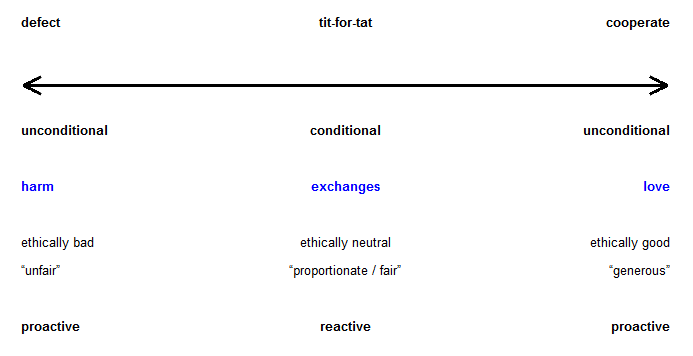
This would seem to be a very reasonable framework for thinking about unconditional love from the points of view of reciprocity, conditionality and benefit/harm.
Unconditional love traditionally exists within two types of contexts, which may or may not be mixed up: 1) some pre-existing situation like being related by family, or some historical reason to feel endlessly grateful or loyal; 2) a temporary partnership of people working towards a common goal.
What these two types share is that one party has a “stake” in the other: there is something about person Q that benefits person P – and therefore, “what is good for Q is good for P“.
This is expressed in the Stakeholder inequality:
s × B > C
“I will help you when the benefit I gain from your increased well being is greater than the cost I incur in helping you.”
s = my stake in your well being (the proportion of your well being that benefits me)
B = the increase in your well being caused by me helping you
> is greater than
C = my cost in helping you.
In other words, the “conditionality” or the point on the spectrum between tit-for-tat and unconditional love depends on the stake that person P has in person Q – what good does person Q do for person P?
If person Q helps person P, then person P will feel towards person Q: 1) a sense of debt and obligation (through the instinct of fair exchanges, tit-for-tat reciprocity); 2) a warm positive regard. The first will result in loyalty, the second in affection. If the stake that person P has in person Q is 100% – if Q has proved to be essential to P – then the loyalty and affection that P feels towards Q will also be 100%.
It is interesting to consider how this increase of “stake” plays out in the opposite, anti-social direction: what happens to it? If the unconditional love end of the spectrum corresponds with cooperation, unconditional harm belongs with competition. Perhaps, if person P is still the recipient and Q is the benefactor, P is now dominating Q to extract what he/she wants, that Q has, through force or manipulation.
November 14, 2017 at 4:34 pm #6118Simon PayntonParticipantIf the stake of P in Q is 100%, then every bit of Q‘s well being is valuable to P. How valuable?
If Q is, unique among all individuals, essential to the existence of P, then for P, the (s × B) of Q (i.e. the value to P of the benefit that Q provides) is as infinite as the value that P feels for all that P values.
Therefore, any [finite] cost incurred by P in helping Q can never be as big as the [infinite] value of the benefit that Q provides for P.
This reminds us of the love that a parent feels for a child. Richard Dawkins might quote the Hamilton inequality, which is equivalent to the Stakeholder inequality, except in terms of genetic relatedness. I think this is it:
r × B > C
where r is the proportion of genetic relatedness. However, unless I’m mistaken about the whole thing, this would seem to demonstrate that a parent will only ever put 50% effort into helping their child, when we all know this is not true. I think the real situation is as described above: the child has infinite value for the parent, and therefore, no cost is ever too great.
I think there is an ambiguity in the inequality, between “overall benefit” and “one time benefit”. Perhaps this is because in real life, the difference between “one time” and “overall” is ambiguous. There are a number of different kinds of situations that could be represented: a one time benefit can last forever.
The Stakeholder inequality could be set out like this:
s × B > C
“I will help you when the benefit I gain from your well being is greater than the cost I incur in helping you.”
s = my stake in your well being (the proportion of your well being that benefits me)
B = the benefit to you caused by me helping you
> is greater than
C = my cost in helping you.
This basically implies looking after someone on an ongoing basis, which is what we would expect if we add in the dimension of time to the present situation of unconditional love.
-
AuthorPosts
- You must be logged in to reply to this topic.